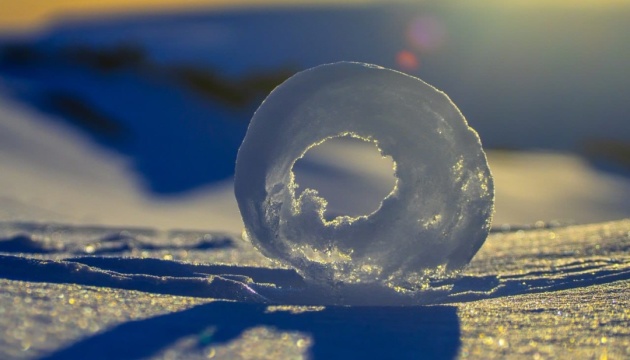
That’s according to Ukraine’s National Antarctic Research Center, Ukrinform reports.
Polar researchers note that multi-layered snow donuts can be both very small – from a few centimeters in diameter, and quite massive – more than a meter in diameter, resembling bales of hay.
Such a phenomenon is quite rare, although it occurs not only in Antarctica.
Snow donuts form when wet snow is peeled off by wind, gravity, and temperature. Therefore certain weather conditions are required for them to take shape – two different layers of snow (frozen or covered with an ice crust, and fresh and fluffy one), a temperature close to the ice melting point, while the force of the wind must be sufficient to moves lumps of snow but not break them apart.
Also, for the formation of snow donuts, a slope is mostly required.
"Given that these rather specific conditions must come together for the snow donuts to appear make them a unique phenomenon that you don’t see too often," polar explorers noted.
As Ukrinform reported earlier, the Cabinet of Ministers extended the term of the national scientific and technical research program in Antarctica until 2025, allowing for continued operation of the Vernadsky Research Base and the Noosphere icebreaker.