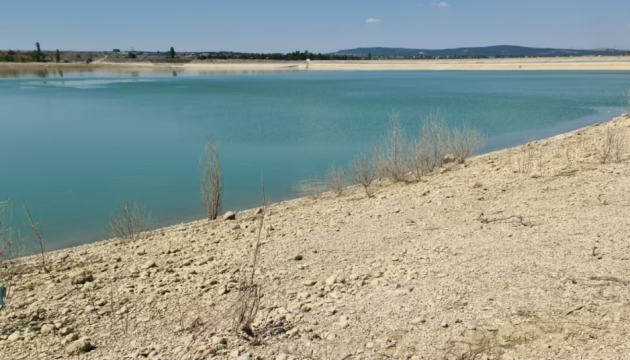
In the temporarily occupied Crimea, water supplies in reservoirs have decreased. Russian hydrologists report that this happened due to the alleged lack of precipitation on the peninsula.
This is reported by the Telegram channel 'Crimean Wind', Ukrinform reported.
"According to hydrologists, since the beginning of autumn, the flow of water in the Crimean reservoirs has decreased: in September, they received a little more than 2.5 million cubic meters. At the same time, 15.78 million cubic meters of water were consumed during the month," the statement said. The reason for this, as noted, was the lack of precipitation in September.
According to Russian hydrologists, the most full reservoirs today are the Isobilne reservoir (85% of the volume, or 11.3 million cubic meters), the Zagorskoe reservoir (83% of the volume, or 23.2 million cubic meters), and the Simferopol reservoir (76% of the volume, or 27.4 million cubic meters). The smallest reserves remain in the Bilohirsk and Taiga reservoirs: they are 32% and 16% full of their design capacity.
Read also:
Special forces land in Crimea, attack Russians
Earlier, Ukrinform reported that the Bilohirsk Reservoir in the temporarily occupied Crimea may lose most of its useful volume by winter. This is due to the fact that the Russians began to intensify water discharge after the North Crimean Canal was drained as a result of the explosion of the Kakhovka hydroelectric power plant dam.